


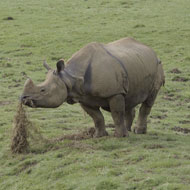
Behan’s irregular reproductive cycles were causing concern
Vets have performed a rare ultrasound on a rhino at ZSL Whipsnade Zoo, after becoming concerned about her reproductive cycles.
Keepers were worried that the zoo’s 22-year-old greater one-horned rhino, Behan, was having irregular reproductive cycles.
Whilst it is rare to put such a large animal under general anaesthetic, owing to the risks, vets said the only way to diagnose Behan’s problem was to carry out an internal scan.
To help with the procedure, zoo vets called in Robert Hermes, an international specialist in rhino reproduction from the Leibniz Institute for Zoo and Wildlife Research in Berlin.
Fortunately, the scan showed that Behan is in good health and the issues with her reproductive cycle can be treated with regular hormone injections.
Whipsnade Zoo’s veterinary officer, Fieke Molenaar said: “To be reassured that she is in good health is great news for all of us that work with Behan.
“It’s also fantastic for the European Endangered Species Programme (EEP), because we now know that, although she is an older female, it may still be possible for her to have another calf… which would be her fifth!”
Greater one-horned rhinos are threatened by expanding human populations in their native Nepal and India. ZSL is working with other organisations in Nepal to protect the species. Improved law enforcement and management of protected areas has helped increase the number of rhinos in Chitwan National Park from 100 to 645 in five decades.
Image © ZSL Whipsnade Zoo


 Companies marketing medicines for small pets exempt from authorisation must submit their annual return to the Veterinary Medicines Directorate (VMD) by 30 November 2026.



