


New study sheds light on rabbit handling
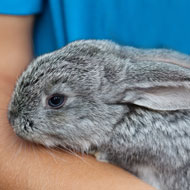
If future research identifies more appropriate handling methods, researchers said this information must be consistent and available across a wide range of media.
A new survey suggests the most popular method of rabbit handling is supporting the animal’s body against the chest, while ‘scruffing’ with rear support is the least popular.
Researchers carried out an online survey of pet owners, breeders, veterinary staff and laboratory personnel, who were shown photographs of five different handling methods.
Out of 2,644 respondents, 86.2 per cent said they had used method B (supporting rabbits against the chest); compared to method E (scruffing), which was used by 15.3 per cent.
Other methods studied were:
- Method A - Rabbit supported with both arms (63.6 per cent)
- Method C - One hand under the chest, the other hand under the bottom, held slightly away from the handler’s chest (53.6 per cent)
- Method D - Rabbit on its back, which can induce tonic immobility (59.9 per cent). However, 71 per cent of participants felt this would be a negative experience for the rabbit. It was mainly used for health checks, grooming or administering medication.
Methods A and E were more commonly used by those with laboratory experience, but E was the least frequently used in all other contexts. Method B was more popular with pet owners and in all other work contexts.
Meanwhile, Methods D and E appeared to prompt a negative emotional response, with 11 participants calling method D ‘wrong’, ‘cruel’, ‘dangerous’ or ‘dreadful’. Likewise, 80 people said method E was ‘cruel’, ‘distressing’, ‘disgraceful’, ‘horrible’, ‘painful’, or ‘uncaring’. Participants were also seven times more likely to say “I was told never to do that”, in response to photos D and E.
Methods A and C were viewed as being the most unfamiliar or difficult to use, but there were fewer welfare concerns about A and B, compared to C, D and E.
The research team, writing in the Journal of Applied Animal Welfare Science, encouraged further research to explore rabbits’ experiences during handling, to identify methods that are easy to use, with the fewest welfare compromises.
However, if future research identifies more appropriate handling methods, researchers said this information must be disseminated in a way that will reach handlers. It must also be consistent and available across a wide range of media in order to have a significant impact on handling and, therefore, rabbit welfare.


 Eligible members of BEVA will be able to vote for their Council team until Monday, 17 August 2026. Members will have received an election email on 17 July.



