


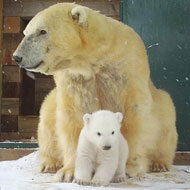
Cub is the first to be born in the UK for 25 years
A polar bear cub has been caught on camera after emerging for the first time since its birth at Highland Wildlife Park.
Zoo keepers announced the birth just before Christmas last year, after they heard high-pitched sounds from the maternity den. However, this is the first time the cub has actually been seen.
Una Richardson, head keeper for carnivores, said the cub’s mother Victoria had started to go outside herself for short periods, but it was not known when her cub would follow.
When she visited Victoria on Sunday morning (4 March), Richardson noticed the cub stepping outside for the first time.
“Suddenly I saw a small, fluffy bundle next to her and had to pinch myself to check I wasn’t seeing things. It was a very special experience and one I’ll never forget. We also have motion-sensitive cameras safely positioned near Victoria’s den and we were delighted to see we had captured her cub’s first few steps outside.”
Up until that moment, keepers had only been able to hear sounds from inside the den, so it was uncertain whether Victoria had given birth to one or two cubs.
“Both mum and cub appear to be doing well, though this is still a sensitive time and they need as much peace and quiet as possible,” Richardson continued. “Our keeper activity at their enclosure will remain at a minimum for the next couple of weeks, after which visitors will be able to see Victoria and our wonderful new arrival.”
Douglas Richardson, head of living collections at the park, added: “We are thrilled with the birth and rearing of a polar bear cub for the first time in the UK for a quarter of a century.
“The birth goes a long way to confirming that our husbandry regime works, with polar bears managed in markedly different ways to many other zoos. This includes having very large, natural enclosures and keeping the sexes in separate parts of the park, which more closely mirrors what happens in the wild.”
Commenting on those who do not feel there is any point breeding polar bears in zoos, Mr Richardson said the question “deserves a serious answer”.
He explained: “The change in the Arctic climate, specifically the shortening of the ice season, coupled with more direct human pressures, is having a noticeably detrimental effect on the species that is likely to result in many of the wild sub-populations disappearing.
“If we do not develop and maintain a genetically and behaviourally robust captive polar bear population, we will not have the option, should we require it, to use them to support what is likely to be a diminished and fragmented wild population in the future.”
Footage of the cub was captured on film for a forthcoming documentary by STV Productions. The programme, Britain’s Polar Bear Cub, will air on Channel 4 at 7pm on Sunday 18 March.
Image © STV Productions/Channel 4


 Companies marketing medicines for small pets exempt from authorisation must submit their annual return to the Veterinary Medicines Directorate (VMD) by 30 November 2026.



