


Some cats may respond quietly to catnip - study
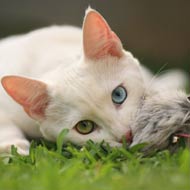
The typical response to catnip is rolling around, rubbing the face on the catnip, sniffing, licking and drooling.
A recent study suggests that nearly all cats respond to catnip, but some do so in a ‘quiet’ manner.
It is generally thought that some cats react to catnip, whereas others don’t. The typical response is rolling around, rubbing the face on the catnip, sniffing, licking and drooling. This response is inherited and around two thirds of cats respond in this way.
Scientists from the Universidad Veracruzana, however, believe that all cats respond to catnip, but not all have an ‘active response’. Some respond passively by reducing activity and assuming the Sphinx position. Furthermore, their study suggests that young kittens under the age of three months do not show the active response, according to findings published by Companion Animal Psychology.
The research team studied 60 cats at a shelter in Veracruz, Mexico. Over three days, cats spent 10 minutes in a cylindrical chamber from which they could not see out. On day four, once they were used to the chamber, they spent five minutes inside before being given catnip. They then spent five more minutes in the chamber with the catnip. Scientists watched videos of the cats’ behaviour before and after catnip was added.
Under half of the adult cats (45 per cent) and 25 per cent of the juvenile cats (three to six months), showed the active response. None of the kittens under three months displayed an active response.
The Sphinx position was most commonly seen in adult cats, while among juveniles it was seen more often in males than females. Male cats spent more time in the Sphinx position and were less likely to miaow, groom or show reduced activity. Cats that had been spayed or neutered early (at six weeks) showed less activity after catnip was presented than cats that were still entire. The frequency of rolling over was not affected by neutering status.
Scientists conclude that the active response to catnip is not affected by sex hormones but by maturation of the brain, meaning young kittens have not matured enough to have an active response. Differing chemicals within the catnip could also be responsible for the differing responses, they added - nepetalactone for the active response and actinidine for the passive. Further research is needed to test this hypothesis, however.
No control was used in the study, which scientists say is not a limitation because of the behaviours they observed. However, they said it would have been useful to demonstrate that the reduced activity responses were down to the catnip rather than other factors, such as anxiety or interest in changes to their environment.
The research team concluded that cats may enjoy catnip even if they do not react by rolling around. Providing scents is a good enrichment activity and scientists advised owners to try a variety of scents, including toys containing catnip or silver vine.


 Eligible members of BEVA will be able to vote for their Council team until Monday, 17 August 2026. Members will have received an election email on 17 July.



