


New vaccine protects horses against strangles
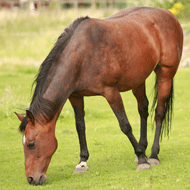
The Strangvac vaccine protected over 80 per cent of horses in the study.
A new protein-based vaccine that protects horses against strangles could available by 2020.
Scientists from the Animal Health Trust (AHT), the Swedish University of Agricultural Sciences, the Karolinska Institute and Interval AB have developed the Strangvac vaccine to protect horses from this devastating disease.
Writing in the journal Vaccine, the researchers report the results of three experiments on 16 horses. The horses were exposed to the strangles infection and monitored twice a day for eight days.
They found that, of the 16 horses vaccinated with Strangvac, just three started to show clinical signs of disease. None of the horses developed adverse reactions following vaccination.
“We are delighted to have shown that our Strangvac vaccine protected over 80 per cent of horses from this dreadful disease,” said Prof. Jan-Ingmar Flock, CEO of Intervacc AB. “Strangles is a scourge of the equine world and the development of Strangvac has the potential to prevent many thousands of horses from falling ill each year.”
“Strangvac is an extremely exciting vaccine” explains Dr. Andrew Waller, head of bacteriology at the AHT. “The vaccine was designed using information from sequencing the DNA of Streptococcus equi and highlights the potential that the genome-era heralds for improving the health of animals and people.
He continued: “Improving the health of horses is a core aim of the Animal Health Trust and we are proud to have helped make this vaccine a reality towards finally breaking the hold this disease currently has on our horses.”
“Transfer of the manufacturing process and production of commercial batches are underway towards the registration and launch of Strangvac,” continued Prof. Flock. “We anticipate that Strangvac will be available for use during 2020.”


 Companies marketing medicines for small pets exempt from authorisation must submit their annual return to the Veterinary Medicines Directorate (VMD) by 30 November 2026.



