


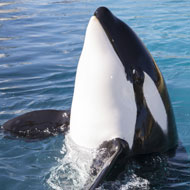
Study provides evidence that orcas can learn new sounds
An orca at a marine park in France has the ability to copy human words such as “hello” and “bye bye”, scientists say.
A research team from the University of St Andrews studied the female orca, named Wikie, at Marineland Aquarium in Antibes, France. Working with the Complutense University of Madrid, they hoped to discover whether orcas could learn new vocalisations by mimicking others.
Wikie was able to repeat words including “Amy” and “one, two, three” by copying her trainer. Researchers say she was often able to produce reasonable imitations on the first attempt, offering ‘conclusive evidence’ that orcas can learn new sounds.
The sounds were made while Wikie was partially immersed in water, with her blowhole exposed to the air.
Apart from humans, whales and dolphins are among the few mammals that can learn to produce a new sound after hearing it.
Scientists have long been aware that wild orcas have calls that are specific to their own pod or set of pods. When captive orcas move to a new environment, they adapt their calls to suit their new environment, but until now, there was no evidence that these varied dialects were the result of learning.
Professor Josep Call from the University of St Andrews, said: “The killer whale we studied in captivity was capable of learning vocalisations of other killer whales and also human vocalisations by imitating them.
“Therefore this result suggests this is also a plausible explanation for how killer whales in the wild learn the vocalisations of other killer whales and how they develop and transmit their dialects.”
A research paper has been published in the Proceedings of the Royal Society B: http://rspb.royalsocietypublishing.org/content/285/1871/20172171


 Companies marketing medicines for small pets exempt from authorisation must submit their annual return to the Veterinary Medicines Directorate (VMD) by 30 November 2026.



