


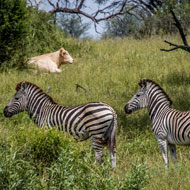
Research could help to improve co-existence with wildlife
Grazing livestock with wildlife could benefit farmers in Africa by reducing parasitic disease, according to new research. Scientists also believe that equipping farmers with the tools to improve livestock health could reduce conflict with wild animals.
Farming on the borders of national parks in Africa often leads to human-wildlife conflict, as farmers believe wild animals bring disease, prey on livestock and damage crops.
However, a new international study suggests that goats in villages with more contact with wildlife are slightly less affected by worms.
Scientists monitored parasitic worm infections in goats around the Makgadikgadi Pans National Park in Botswana, to find out how infection levels were related to weather and the migrations of African wildlife, such as zebra and wildebeest.
Computer simulations, developed to predict infection patterns, suggest that wild animal species that are not suitable hosts for goat worms, are eating contaminated grass - thereby removing parasites from the pasture.
Dr Kate Evans, director of Elephants for Africa, said: “The results show that by equipping farmers with the tools and knowledge to take care of their goats, we can promote healthy and peaceful co-existence with wildlife, and improve livelihoods at the same time.
As human populations increase in Africa, it is crucially important that we are able to do this if many of the wild animals we know and love are to survive.”
The team spent months working with farmers, teaching them how to inspect their animals for signs of infection and decide which ones to treat. By targeting treatment to infected animals only, they managed to improve herd health at 25 per cent of the cost.
Farmers were also given simple tools to clinically evaluate the health of their goats. These methods were developed by the University of Pretoria and are now being tested in new areas. Researchers plan to extend the technology in Botswana and other parts of the world, such as Malaysia, India and the UK.
Lead author Dr Josephine Walker, from the University of Bristol, explained: “The risk of worm infection in goats was closely related to rainfall, but weather patterns are changing and it is hard for farmers to know when is the best time to treat.
"By formalising our understanding of the processes involved in a computer simulation, we can better understand how rainfall patterns match with infection levels.
“Access to technology, especially through mobile phones, is growing quickly across Africa, which provides us with an opportunity to deliver hi-tech solutions to remote rural communities.”


 Companies marketing medicines for small pets exempt from authorisation must submit their annual return to the Veterinary Medicines Directorate (VMD) by 30 November 2026.



