


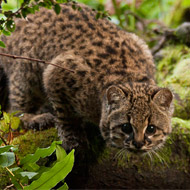
Study reveals hope for Chile’s vulnerable feline
Conservationists have discovered that the güiña wildcat from Chile is surprisingly adaptable to forest loss.
For many years, researchers assumed that deforestation and human persecution were major causes of the güiña’s decline. But findings published in the Journal of Applied Ecology suggest this is not the case.
The paper shows that large intensive farms are actually well-suited to the species because they often contain un-farmed areas that provide the güiña with food and shelter.
As such, the authors conclude: ‘Farmers with large properties are key stakeholders in the conservation of this species and must be at the centre of any conservation interventions that aim to protect existing native forest vegetation within farmland’.
With an estimated population of less than 10,000 individuals, the güiña has been listed as Vulnerable on the IUCN Red List since 1996. The species is notorious for attacking livestock so is perceived negatively by local farmers.
Until now, it had been assumed that human persecution, coupled with extensive farming, had seen the güiña’s habitat fall by as much as 70 per cent. To investigate further, researchers from the Durrell Institute of Conservation and Ecology conducted a series of questionnaires, camera-trap surveys and remote-sensed images.
They found that the real cause behind the güiña’s decline is habitat fragmentation and the subdivision of large farms into smaller ones. Dr Nicolás Gálvez, now a lecturer at the Pontificia Universidad Católica de Chile, explains:
“Land subdivision and fragmentation have a far bigger impact on güiña survival.
This is because there is a higher risk of human interaction and persecution in areas where there are more farms, a greater pressure on natural resources through increased timber extraction and livestock grazing, and even competition for food from domestic animals kept as pets.”
Image (C) Jerry Laker


 Companies marketing medicines for small pets exempt from authorisation must submit their annual return to the Veterinary Medicines Directorate (VMD) by 30 November 2026.



