


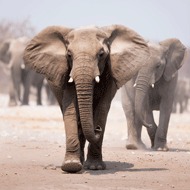
US researchers analyse the effect of war on wildlife
Sustained conservation activity in war zones may help to save many at-risk populations and species, a new study has concluded.
Writing in the journal Nature, researchers show that it is the frequency of conflict that affects the severity of population declines, and not the intensity. The study analysed wildlife population declines in Africa from 1946 to 2010 - a period when conflict was extensive.
‘Although individual conflicts can have either positive or negative impacts on wildlife populations, we show that the overarching trend is negative, and that even low-grade, infrequent conflict is sufficient to drop population trajectories below replacement,’ the authors write.
Due to the high frequency, extent and duration of conflict in Africa, large mammal populations are in sharp decline.
A recent study found that incorporating conflict risk into protected-area planning improved conservation outcomes. However, its authors noted that the lack of information about war’s ecological impacts remains scarce.
In this new study, Joshua Daskin (Yale University) and Robert Pringle (Princeton University) assessed the effect of war on 253 wildlife populations across Africa. They analysed data collected between 1946 and 2010, including populations of endangered species such as elephants and hippopotamus.
They found that 70 per cent of protected areas were affected by conflict during this period, and that conflict frequency was the single most important predictor of wildlife trends.
The study is the first of its kind to analyse quantitatively how war affects wildlife over continental and multi-decade scales. While population collapse sometimes occurred, the authors said that it was infrequent, 'suggesting that war-torn faunas can often recover'.


 Companies marketing medicines for small pets exempt from authorisation must submit their annual return to the Veterinary Medicines Directorate (VMD) by 30 November 2026.



