


R sanguineus ticks found on imported dog
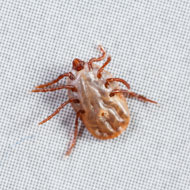
Female Rhipicephalus sanguineus tick (stock photo).
A rescue dog recently imported to the UK from Greece was found to be infested with immature brown dog ticks, despite receiving preventative treatment prior to arrival.
The case was reported in Vet Record letters by experts from ESCCAP, Midland Veterinary Surgery, the University of Bristol and the University of Liverpool.
Authors said the case demonstrates that it cannot be assumed that any dog treated for ticks before entering the UK is tick-free. It also highlights ‘the potential for the establishment of brown dog ticks and tick borne disease in the UK,’ they warned.
Just 18 hours after arriving in the UK, the Jack Russell crossbreed was taken to Midland Veterinary Surgery in east London with approximately 50 or more ticks. They were visible on the skin between the digits, with fewer on the rest of the body.
Closer examination at the Institute of Veterinary Science, University of Liverpool, revealed they were larvae of Rhipicephalus sanguineus complex. This was later confirmed by Public Health England’s Tick Surveillance Scheme.
The dog had reportedly been treated 48 hours previously with an appropriate and licensed spot-on product.
Authors of the letter said the case ‘raises a number of important points for veterinary professionals’. All feeding stages of the tick are vectors for Babesia vogeli. Many of the specimens in this case were fully fed, a process that takes at least two or three days, meaning there was sufficient time for pathogen transmission.
Furthermore, infestation ‘is likely to have occurred just before the dog was exported, so it is possible that some ticks that engorged before treatment might subsequently leave the host and act as a source of household infestation in the UK’.
Ongoing awareness of exotic ticks and tickborne diseases is ‘essential’, they added, and there are useful online tools for identifying ticks (such as bristoluniversitytickid.uk). However, identification of larvae and nymphs can be difficult, so specialist services, such as that provided by PHE, are recommended.
The authors concluded: ‘While treatment before UK entry is an important step in exotic tick and tickborne disease control, it will only be effective in combination with close surveillance, particularly where rescue animals are imported from areas known to be of a higher risk.’


 Eligible members of BEVA will be able to vote for their Council team until Monday, 17 August 2026. Members will have received an election email on 17 July.



