


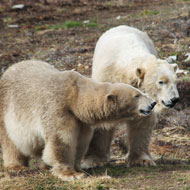
The birth of the UK’s first polar bear cub in 25 years has been confirmed by the Royal Zoological Society of Scotland (RZSS).
Polar bears Victoria and Arktos, both residents of RZSS Highland Wildlife Park, mated during the breeding season in March.
Keepers say they heard distinct, high-pitched sounds coming from Victoria’s maternity den, which is closed to visitors. The sounds began the week before Christmas and have continued into the new year.
Head keeper Una Richardson, who is responsible for carnivores, said: “Because we don’t have sight inside her cubbing box we can’t be sure if Victoria has had more than one cub, but we can confirm the birth.”
Although the birth has been welcomed as an “outstanding achievement”, staff at the park say the first three months of life are ‘perilous’ for polar bear cubs, whether they are born in the wild or in captivity.
Richardson explained: “While we are absolutely thrilled, we are not celebrating prematurely as polar bear cubs have a high mortality rate in the first weeks of life due to their undeveloped immune system and the mother’s exaggerated need for privacy, with any disturbance risking the cub being killed or abandoned.”
Staff will continue to monitor Victoria and her enclosure will remain closed to the public. Keeper activity will also be at a minimum to give her cub the best chance of survival. She is expected to emerge around March.
RZSS chief executive Barbara Smith said: “The birth of the first polar bear cub in the UK for a quarter of a century is an outstanding achievement which will arouse interest around the world. It is a testament to the commitment and professionalism of our team and hugely exciting.”
Polar bear populations are expected to decline significantly over the next 40 years with the reduction in sea ice, which is the polar bear’s primary platform for hunting seal.
Smith added: “Our polar bears are part of the European Endangered Species Programme and we hope Victoria’s offspring will survive to reinforce the captive population, which may be needed in future to augment and help restore a markedly reduced and fragmented wild population.”
Image © RZSS/Gavrielle Kirk-Cohen


 Companies marketing medicines for small pets exempt from authorisation must submit their annual return to the Veterinary Medicines Directorate (VMD) by 30 November 2026.



