


Mystery illness claims millions of kangaroos
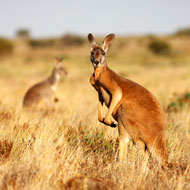
Population estimates also suggest declines in red and grey kangaroos across the Western Plains of New South Wales.(Stock photo)
A mystery illness is thought to have killed millions of kangaroos across the Western Plains of Australia over the past year.
Red and grey kangaroos have reportedly been found by researchers with “massive haemorrhaging”, total or partial blindness, internal bleeding around the joints, stilted movement and inflammation.
Veterinarian and lead researcher Greg Curran told The Australian: “It’s a disease, it’s not a genetic problem. We haven’t been able to find a bacteria, we haven’t been able to find a virus. Parasites, they aren’t part of it. Given the huge area and different kinds of country and feed, it’s very unlikely to be a plant poisoning. You’ve ruled out all the known causes of diseases.”
Population estimates also suggest declines in red and grey kangaroos across the Western Plains of New South Wales. According to the NSW Office of Environment and Heritage, there were thought to be more than 6.3 million red kangaroos in 2016, but in 2017, the figure fell to around 5.1 million. Similarly, there were an estimated 6.3 million grey kangaroos in 2016, and just under 3.9 million in 2017.
Steve McLeod, senior research scientist at the NSW department of primary industries, told The Australian: “There has been substantial drops right across the Western Plains. Except for the Griffith zone in the southeast.”
Dr Curran added: “The drop is so great it can’t simply be due to culling rates. The number of animals that have been harvested for the meat market is low. It can’t possibly be starvation or malnutrition.”
Investigations are ongoing, with researchers examining whether rainfall could be having an effect, as there has been a correlation between relative rainfall and kangaroo numbers that is delayed by a couple of years.


 Companies marketing medicines for small pets exempt from authorisation must submit their annual return to the Veterinary Medicines Directorate (VMD) by 30 November 2026.



