


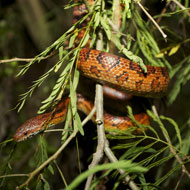
A potentially deadly fungal disease in snakes could become global in scale, scientists are warning, as new research suggests all snakes could become infected.
New research shows that the fungal disease caused by Ophidiomyces ophidiodiicola can infect many species of snake, regardless of their ancestry, physical characteristics or habitats.
The research, published in the journal Science Advances, suggests that all 98 groups of snakes in the eastern US could be susceptible, and the epidemic may extend globally.
Scientists say future surveys for the disease should assume all snake species harbour this pathogen.
“This really is the worst-case scenario,” said lead author Frank Burbrink, an associate curator at the American Museum of Natural History. “Our study suggests that first responders shouldn’t just be looking for certain types of snakes that have this disease, but at the whole community. All snakes could become infected, or already are infected.”
This emerging disease has been reported in 23 wild species in the US, primarily in rat snakes, milk snakes, garter snakes and viperids in the eastern part of the country. It was also recently identified in three species commonly found in Europe.
Affected snakes form lesions that can spread quickly and cover large parts of the body. Shedding can resolve most cases, but the infection can be fatal. Behavioural changes, such as increased basking as the skin sheds, also put them at risk of predation, starvation or environmental exposure.
Karen Lips, a professor of biology at the University of Maryland said: “Scientists have learned a lot about research and monitoring needs from 25 years of studying the effects of chytrid fungi on amphibians, and those lessons tell us that prevention is the best policy.
“Researchers need to work with decision makers to prevent snake fungal disease from spreading, survey museums and field sites to determine the current distribution of the disease, run trials in the lab, and start working on treatments.”


 Companies marketing medicines for small pets exempt from authorisation must submit their annual return to the Veterinary Medicines Directorate (VMD) by 30 November 2026.



