


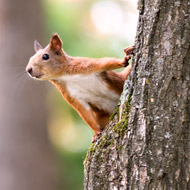
Public urged to report any dead or dying squirrels
The Animal and Plant Health Agency (APHA) has reported the first laboratory-confirmed cases of disease caused by squirrel pox virus (SQPV) in Welsh red squirrels.
In a letter to Vet Record (Vol 181 No 19), the APHA said that two squirrels were found dead in Gwynedd, an area of north-east Wales. The discovery means that England, Scotland, Wales and Northern Ireland now have recorded cases of the disease.
Since the discovery, the APHA notes that it has set up cameras to monitor wildlife in woodland close to where the squirrels were found. It added that the outbreak shows the need to have intense red squirrel conservation efforts in place.
This includes grey squirrel management strategies where appropriate, the APHA said, ‘especially in areas where red squirrels are known to be present’.
According to the APHA, three further red squirrel carcasses have been found on Anglesea, two of which had suspicious facial lesions. These were sent to the APHA for analysis but no SQPV particles were found.
Despite this, the Red Squirrel Trust Wales is calling on members of the public to report any dead or dying squirrels and to clean squirrel feeders regularly using an anti-viral wash or spray.
‘It may be wise to cease feeding red squirrels altogether, as at this time of year there are plenty of wild foods available,’ the organisation writes on its website.
‘Alternatively, you can simply scatter small amounts of food on the ground so that animals are no longer congregating at a wooden feeder, but still visit your garden.’
Squirrel pox is an often fatal disease that is thought to be a significant factor in the decline of red squirrels. It is not yet understood how the disease spreads, but visible symptoms include lesions or scabs around the eyes, mouth, feet and genitals. Squirrels also become more lethargic as the disease progresses.


 Companies marketing medicines for small pets exempt from authorisation must submit their annual return to the Veterinary Medicines Directorate (VMD) by 30 November 2026.



