


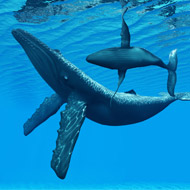
Mammals ‘talk’ to each other and use ‘name’ recognition
A major new study has linked the complex culture and behaviour of whales and dolphins to the size of their brains.
The research, published in Nature Ecology & Evolutions, found overwhelming evidence that whales and dolphins have sophisticated social and cooperative behaviour traits, similar to many found in human culture.
The study demonstrates that these social and cultural characteristics are linked with brain size and brain expansion - a process called encephalisation.
The research was conducted by scientists at The University of Manchester, The University of British Columbia, Canada, The London School of Economics and Political Science (LSE) and Stanford University, United States
“As humans, our ability to socially interact and cultivate relationships has allowed us to colonise almost every ecosystem and environment on the planet,” said Dr Susanne Shultz, an evolutionary biologist at The University of Manchester. “We know whales and dolphins also have exceptionally large and anatomically sophisticated brains and, therefore, have created a similar marine-based culture.”
She continued: “That means the apparent co-evolution of brains, social structure, and behavioural richness of marine mammals provides a unique and striking parallel to the large brains and hyper-sociality of humans and other primates on land. Unfortunately, they won’t ever mimic our great metropolises and technologies because they didn’t evolve opposable thumbs.”
Researchers assessed 90 different species of dolphins, whales, and porpoises and produced a long list of behavioural similarities shared with humans and other primates. The list includes:
• complex alliance relationships – working together for mutual benefit
• social transfer of hunting techniques – teaching how to hunt and using tools
• cooperative hunting
• complex vocalisations, including regional group dialects – ‘talking’ to each other
• vocal mimicry and ‘signature whistles’ unique to individuals – using ‘name’ recognition
• interspecific cooperation with humans and other species – working with different species
• alloparenting – looking after youngsters that aren’t their own
• social play
The researchers argue that large brains are an evolutionary response to complex and information-rich social environments. However, this is the first study of its kind to apply these hypotheses to ‘intelligent’ marine mammals on such a large scale.


 Companies marketing medicines for small pets exempt from authorisation must submit their annual return to the Veterinary Medicines Directorate (VMD) by 30 November 2026.



