


Results show domestication has not made dogs more tolerant
A study conducted by researchers in Vienna has concluded that wolves are better team players than domesticated dogs.
Researchers at Vetmeduni Vienna found that wolves work well together if they need to cooperate to gain a piece of food. Conversely, similarly-raised and kept dogs were not able to cooperate - despite showing the same interest in the task.
Scientists say their results show that the sociological background of wolves gives them an advantage when it comes to teamwork. Study author Friederike Range explains:
"Wolves generally have a stronger exploratory urge to investigate things. However, they clearly outperformed the dogs when co-operating was the only chance for success.”
In the wild, wolves raise their pups in groups and hunt together. Free-ranging dogs, however, look after their own offspring and individually hunt for food.
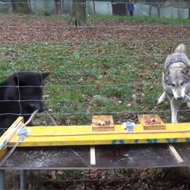
In the study, researchers assessed groups of dogs and wolves with a “loose-string” test. Teams of two had to pull the two ends of a rope at the same time in order to move a feeding tray towards them.
In the first test, the animals were not trained and were expected to grasp the task over several attempts. Five out of seven wolves managed to co-operatively pull at the same time. Only one of eight sets of dogs, however, were able to solve the task.
In the second test, four wolf and six dog groups were trained on the string pulling task. They were then given six attempts to work out how to do it.
Again the wolves showed they were better at working together than the dogs. Three of the four wolf groups could repeatedly pull the tray at the same time. In the dog group, only two pairs solved the problem once.
Many theories exist about the positive influence of domestication on tolerance and co-operation. However, researchers say these should now be called into question.
"Studies with pet dogs showed that dogs are also able to work well together. However, it is likely that in this case education by owners plays a decisive role,” the authors explain. “Whoever keeps several dogs at home will educate them in such a way that they tolerate each other facilitating cooperation. Because of this it was essential to test wolves and dogs raised in the same way that in a pack environment.”
The study Importance of a species’ socioecology: Wolves outperform dogs in a conspecific cooperation task, is published in Proceedings of the National Academy of Sciences.
Image (C) Vetmeduni Vienna


 Eligible members of BEVA will be able to vote for their Council team until Monday, 17 August 2026. Members will have received an election email on 17 July.



