


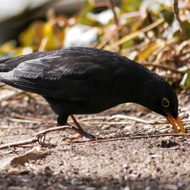
Virus responsible for mass bird die-off in 2001
A disease that caused severe blackbird die-off in Austria has re-emerged, not only in blackbirds but also in humans.
First discovered in 2001, Usutu virus caused severe wild bird mortality in Eastern Austria. It mainly affected blackbirds but other songbirds suffered too.
In the past decade, no cases of Usutu virus have been observed in Austria. But cases have been reported in other parts of Europe, including neighbouring Hungary.
In 2016, Usutu virus was confirmed in two deceased blackbirds from Austria - and in 2017 in sixteen songbirds. Researchers at Vetmeduni Vienna investigated the virus strains involved.
In a separate study, Usutu virus was demonstrated in seven human blood donations from eastern Austria, suggesting that human infections seem to be more frequent than first thought.
“We were surprised to see after 10 years of absence last year the reemergence of Usutu virus in Austria. Also, other European countries reported last year widespread Usutu virus activity,” says principal investigator Norbert Nowotny from the Institute of Virology.
“We, therefore, investigated the genetic set-up of the Austrian and Hungarian viruses in order to enhance our understanding which virus strains are currently active in the regions and from where they have been introduced.”
Researchers note the viruses identified in Hungary between 2010 and 2015 were closely related to the ‘original’ virus strain that was responsible for the mass bird die-off in Austria. The viruses found in 2016 for both countries, however, turned out to be related to virus strains which circulated in Italy during 2009 and 2010.
Because these two variants belong to two different genetic lineages, this ‘demonstrates that various virus strains are exchanged between neighbouring countries’, explains Nowotny.
Usutu virus (USUV) is an African mosquito-borne virus that is closely related to West Nile Virus. Human Usutu virus infections are normally asymptomatic, sometimes resulting in fever and rash.
Neurologic symptoms and severe courses of the disease are rare in humans. However, critical illness was reported in 2009 in two immunosuppressed patients from Italy.
The study, Usutu virus, Austria and Hungary, 2010–2016, is published in Emerging Microbes & Infections.


 Companies marketing medicines for small pets exempt from authorisation must submit their annual return to the Veterinary Medicines Directorate (VMD) by 30 November 2026.



