


WWF calls for new Marine Protected Area in East Antarctica
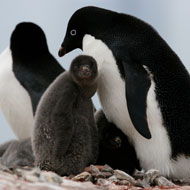
A colony of Adélie penguins has suffered a ‘catastrophic’ breeding failure in Antartica, with only two chicks surviving. Conservationists are calling for greater protection for the waters off East Antarctica to prevent further negative impacts.
WWF says thousands of chicks starved to death as a result of unusually extensive sea ice late in the summer, which meant adult penguins had to travel further to forage for food.
Four years ago, the colony - which then numbered just over 20,000 pairs and now numbers over 18,000 - failed to produce a single chick. Many chicks became saturated and froze to death, owing to heavy sea ice, coupled with unusually warm weather and rain, followed by a rapid drop in temperature.
Adélie penguins are, on the whole, faring well in East Antarctica, but declining in the Antarctic peninsula region where climate change is well established.
The Commission for the Conservation of Antarctic Marine Living Resources (CCAMLR) is due to meet today (16 October), to consider proposals for a new Marine Protected Area (MPA) for the waters off East Antartica. The proposal has been on the table for eight years, but has yet to be agreed.
WWF says an MPA would help to secure a future for East Antartica’s wildlife and marine biodiversity, including Adélie and emperor penguins.
Rod Downie, head of polar programmes at WWF-UK, said: “The risk of opening up this area to exploratory krill fisheries, which would compete with the Adélie penguins for food as they recover from two catastrophic breeding failures in four years, is unthinkable. So CCAMLR needs to act now by adopting a new Marine Protected Area for the waters off East Antarctica, to protect the home of the penguins.”
Senior penguin scientist, Yan Ropert-Coudert, from the French National Centre for Scientific Research, added: “The region is impacted by environmental changes that are linked to the breakup of the Mertz glacier since 2010. An MPA will not remedy these changes but it could prevent further impacts that direct anthropogenic pressures, such as tourism and proposed fisheries, could bring.”
The MPA proposal initially comprised seven large marine areas off the coast of East Antarctica, but was later reduced to four. It is anticipated that only three of those will be adopted this year, however. WWF says it is particularly important that the D’Urville Sea Mertz region is kept off limits to krill fisheries, to protect the foraging and breeding grounds of Adélie penguins.
Image © Natalie Bowes / WWF-Canada


 Companies marketing medicines for small pets exempt from authorisation must submit their annual return to the Veterinary Medicines Directorate (VMD) by 30 November 2026.



