


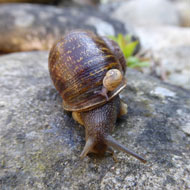
Genetic research continues with Jeremy’s offspring
The ‘one in a million’ garden snail with a left-coiling shell, has died, scientists have confirmed.
Jeremy the ‘lonely’ snail achieved worldwide fame after Dr Angus Davison from the University of Nottingham, launched an appeal to find him another left-coiling snail to mate with. As a result, six other ‘lefty’ snails were found around the world, allowing scientists to study the inheritability of the variation for the first time.
Jeremy was found dead on Wednesday (11 October), but scientists say he managed to produce offspring shortly before his death. Fellow ‘lefty’ snail Tomeu - who was found on a snail farm on Majorca - has produced a batch of 56 babies, around one third of which are likely to have been ‘fathered’ by Jeremy.
All offspring were born with right-coiling shells, which is thought to be because the mother’s genes determine shell-coil direction. Scientists say it is far more likely that left-coiling babies will be seen in the next generation, or even the generation after that.
“This may be the end for Jeremy,” Dr Davison said, “but now that the snail has finally produced offspring, this is a way point in our long term research goal to understand the genetics of body asymmetry.
“Ultimately, we would like to know why these snails are so rare, but also how the left and right sides of the body are signalled at the molecular level, and whether a similar process is taking place during human development.”
Jeremy was found in South West London by a retired scientist, who contacted Dr Davison because of his interest in snail genetics. In 20 years of working with snails, Dr Davison had never seen a left-coiling - or ‘sinistral’ - snail. He wanted to find out whether it was an inherited trait or a developmental quirk. His research could have implications for body asymmetry in humans.
Dr Davison and colleagues recently discovered a gene that determines whether a snail’s shell twists left or right. This gene also affects body asymmetry in other animals, including humans. Their research could help to improve our understanding of how organs are placed in the body and why this process can sometimes go wrong, when some or all of the major internal organs are reversed.
Jeremy’s shell has been preserved and placed in the university’s natural history collection. It will be used to teach students about this rare genetic variant.
Image © Dr Angus Davison


 Companies marketing medicines for small pets exempt from authorisation must submit their annual return to the Veterinary Medicines Directorate (VMD) by 30 November 2026.



