


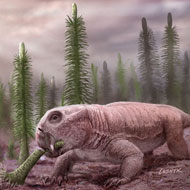
Study may offer insights into future changes to biological communities
New research suggests mass extinctions have predictable outcomes for animal distributions, and could potentially guide our modern conservation efforts.
International scientists found that mass extinctions in the late Permian to early Jurassic periods, were followed by periods of low diversity, in which certain new species dominated large parts of the supercontinent, Pangaea.
The findings have been published in Nature Communications.
It has previously been thought that mass extinctions create ‘disaster faunas’, but studies had been rare and limited in scope.
Researchers involved in the present study looked at long-term changes in biodiversity in Pangaea. They analysed nearly 900 animal species between 260 million and 175 million years ago. The period saw two mass extinctions and the origin of dinosaurs and many modern vertebrate groups.
The end-Permian extinction wiped out many groups that dominated life on land and allowed new groups to evolve. This included the earliest dinosaurs, crocodiles and relatives of mammals and lizards. The end-Triassic extinction then wiped out many major groups, which helped to ‘set the stage’ for dinosaurs to take over.
David Button, of North Carolina State University, explained: “These results show that, after both mass extinctions, biological communities not only lost a large number of species, but also became dominated by widespread, newly-evolving species, leading to low diversity across the globe.
“These common patterns suggest that mass extinctions have predictable influences on animal distributions and may have the potential to guide modern conservation efforts.”
We are currently in the sixth mass extinction due to human activity. Already, there are concerns that global faunas are becoming more homogenous due to landscape simplification, rising temperatures and the introduction of exotic species. Researchers say their findings highlight another risk factor - ongoing biodiversity loss is expected to result in a ‘disaster fauna’ of more similar species worldwide.
Image © Victor O. Leshyk, website: victorleshyk.com


 Companies marketing medicines for small pets exempt from authorisation must submit their annual return to the Veterinary Medicines Directorate (VMD) by 30 November 2026.



