


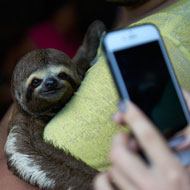
‘Selfies’ with wild animals are on the rise as tourists increasingly want to snap their ‘once in a lifetime experience’. But the practice is driving the suffering and exploitation of wild animals in the Amazon, an investigation has found.
World Animal Protection says animals are being snatched from the wild - often illegally - and used by irresponsible tour operators to entertain and provide photo opportunities for tourists.
Research shows there has been a 292 per cent rise in the number of wildlife selfies being posted on Instagram since 2014. Over a quarter of these show someone hugging, holding or otherwise interacting inappropriately with a wild animal.
World Animal Protection explored two gateway cities of the Amazon - Manaus, Brazil and Puerto Algeria, Peru. In Brazil, direct contact with wild animals for photos was offered on 94 per cent of excursions, at six separate locations. And on 77 per cent of excursions, the official tour operator actively encouraged this type of activity.
Meanwhile, in Peru, a total of 40 animals across 24 species were identified. Five of these are ‘threatened’ according to the IUCN and 75 per cent are listed by Cites.
Behind the scenes investigators found evidence of cruelty, including:
- Sloths captured from the wild and tied to trees with rope, surviving no longer than six months
- Birds with severe abscesses on their feet
- Wounded and dehydrated green anacondas
- Caiman crocodiles with rubber bands around their jaws
- An ocelot kept in a small empty cage
- A manatee in a tiny tank outside a hotel
- A giant anteater being manhandled and beaten by its owner
World Animal Protection’s CEO, Steve McIvor, commented: “The wildlife selfie craze is a worldwide phenomenon fuelled by tourists, many of whom are unaware of the abhorrent conditions and terrible treatment wild animals can endure to provide that special souvenir photo.
“Behind the scenes wild animals are being taken from their mothers as babies and secretly kept in filthy, cramped conditions or repeatedly baited with food causing severe psychological trauma.”
The charity’s global wildlife advisor, Dr Neil D’Cruze, said there are also conservation concerns. An online review of wildlife selfies in Latin America found over 20 per cent of species involved are threatened with extinction, and over 60 per cent are protected by international law.
World Animal Protection is urging relevant governments to enforce the law and has been in contact with Instagram to discuss its animal protection policies. It is also encouraging people to sign up to its Wildlife Selfie Code, which is a promise not to take wildlife selfies if these involve inappropriate interactions with the animal.
Image © World Animal Protection / Nando Machado


 Companies marketing medicines for small pets exempt from authorisation must submit their annual return to the Veterinary Medicines Directorate (VMD) by 30 November 2026.



