


Video footage captures penguins eating jellyfish
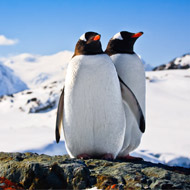
Researchers filmed penguins across the sounthern oceans eating and attacking jellyfish.
Video footage obtained by an international team of scientists has revealed that jellyfish are a widespread food source for penguins.
It was previously thought that penguins only accidentally ate jellyfish when targeting another source of prey nearby. But results published in the journal Frontiers in Ecology and the Environment show this is not the case.
In the study, researchers strapped video loggers to 106 penguins from four species at seven breeding localities across the southern oceans. They then analysed over 350 hours of footage to document the prey consumed by each individual penguin.
The team was surprised to find that all penguin species, at all localities, consumed at least one gelatinous animal over the course of 1.5 to five hours. They recorded around 200 attacks, with with some penguins repeatedly attacking jellyfish during their hunt.
“When we saw the footage…we could finally see that the penguins indeed go for the jellies themselves,” Jean-Baptiste Thiebot, a postdoctoral fellow at Japan's National Institute of Polar Research and lead author on the study, told National Geographic. “This was happening not only in the Antarctic but apparently all across the southern oceans.”
It is not yet understood why penguins eat jellyfish. Compared with other prey such as crustaceans and fish, gelatinous animals are very low in energy. Indeed, 95 to 98 per cent of their wet mass is water and salt.
The scientists suggest that the low energy reward of jellies might be balanced out by their ease of capture, or that they might not be eating jellies for energetic purposes. The researchers also note that because jellies are carnivores, they may be a good concentration of food to target.
The authors are now set to analyse the biochemical composition of jellyfish to learn why they would be so interesting to penguins. They will also continue to use the data loggers on a wide array of marine predators to reveal predator-prey relationship across the world.


 Companies marketing medicines for small pets exempt from authorisation must submit their annual return to the Veterinary Medicines Directorate (VMD) by 30 November 2026.



