


Researchers analyse global database of body masses
The world’s biggest and smallest vertebrates are at most risk of extinction, according to new research.
The study, published in Proceedings of the National Academy of Sciences of the United States of America, reveals the likelihood of being threatened is significantly related to body size for birds, fish and mammals.
In the collaborative study, researchers built a global database of body masses for some 27,000 vertebrate species assessed by the International Union for Conversation of Nature’s Red List.
They found that the extinction risk changes around a body mass breakpoint of 0.035kg, suggesting that the lightest and heaviest animals have elevated extinction risk.
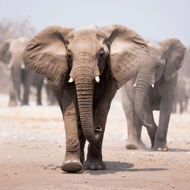
A review of the key drivers of extinction risk showed that the heaviest animals are most threatened by hunting, while the lightest animals are threatened by habitat loss due to logging and pollution.
Researchers said that knowing which creatures are at risk can help focus conservation efforts.
‘Our results offer insight into halting the ongoing wave of vertebrate extinctions by revealing the vulnerability of large and small taxa, and identifying size-specific threats,’ the authors write.
‘Moreover, they indicate that, without intervention, anthropogenic activities will soon precipitate a double truncation of the size distribution of the world’s vertebrates, fundamentally reordering the structure of life on our planet.’


 Companies marketing medicines for small pets exempt from authorisation must submit their annual return to the Veterinary Medicines Directorate (VMD) by 30 November 2026.



