


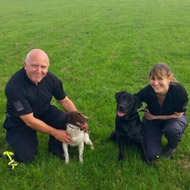
Rob and Tweed are ready to fight terrorism, paedophiles and fraudsters
Two British police dogs have become the first and only outside of the USA to be trained to detect digital storage devices.
Devon and Cornwall Police have trained the dogs to sniff-out USB sticks, hard drives, SD cards, computers and mobile devices.
Black Labrador Rob and springer spaniel Tweed have already been used by police at crime scenes across the UK.
“This is an historic step for the Alliance and policing in the UK," said chief superintendent Jim Nye, commander for the Alliance Operations Department. “These dogs will give the police a new way to fight the threat of terrorism, paedophiles and fraudsters.”
Police constable Graham Attwood began researching the ability to train such a dog in May 2015. He discovered that the first dogs in the world to train in digital storage detection were trained at the Pioneering Connecticut State Police Dog Unit in the USA. Following his collaboration with Connecticut State police and FBI, he began a pilot scheme in December 2016.
“Myself and members of the alliance dog school initially handled and trained Tweed and Rob, mainly in our own time, as we were committed to our usual daily duties of training the force’s other operational police dogs,” said PC Attwood.
“The majority of the dogs we have in the force either come from our puppy breeding scheme or are gift or rescue dogs, but this was a unique challenge for us so we identified and purchased Tweed and Rob last December when they were around 15 months old, and embarked on this journey with them.”
In March 2016, recently retired Connecticut State Police Dog Instructor Mike Real, together with special agent Jeffrey Calandra - the only Digital Detection Dog handler in the FBI, were invited to Devon to train with and assess Tweed and Rob. Over the course of three days, the dogs were put through their paces and tested on their operational search abilities.
“In today’s tech-driven world, crime has no state or even country boundaries, so helping our law-enforcement partners around the world develop cutting edge detection capabilities is key to fighting crime and terror,” said Mr Calandra.
PC Attwood added: “Our digital dogs have already proven to be a success and have been used in over 50 warrants executed across the UK, including Hampshire, Essex, South Wales, and North Yorkshire.
"We have already seen some really fantastic results from these two dogs. Tweed on one warrant indicated that something may have been within what looked like a coke can. This was then inspected by a search officer and discovered that it was actually a money box which had a number of SD cards hidden within it.
“Rob has also indicated a small device hidden carefully in a drawer which would have likely been missed by the human eye, which just goes to show that they are able to locate these items which assists us greatly with our searches.”
The force will now assess the success of Tweed and Rob with a view to rolling out the trial. The dogs live at home with their new full-time police dog handlers, PC Martin King and PC Jill Curnow.
Image (C) Devon and Cornwall Police.


 Eligible members of BEVA will be able to vote for their Council team until Monday, 17 August 2026. Members will have received an election email on 17 July.



