


Dogs and wolves able to understand human cues
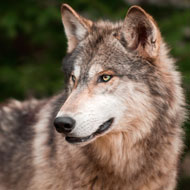
Both the dogs and wolves were able to follow the communicative cues to find the food.
Dogs may have lost some of their problem solving abilities when they were domesticated, according to a new study which suggests that wolves are better at understanding cause and effect.
Wolves were also found to be just as good at understanding human communications as their domesticated counterparts.
Researchers at the Wolf Science Centre in Vienna compared wolves and dogs living in almost identical environments. An international team explored the reasoning abilities of 14 dogs (including household pets and dogs living in a pack setting) and 12 human-socialised wolves.
The animals were given a choice of two objects, one containing food and the other empty. Researchers investigated whether the dogs and wolves could make use of certain hints from humans to find the right container. These included communicative cues such as eye contact and pointing; behavioural cues such as reaching for the container or trying to open it; and causal cues in the absence of a human, such as the container with food making a noise when shaken.
Both the dogs and wolves were able to follow the communicative cues to find the food, which came as something of a surprise as it is widely believed that domesticated dogs are more adept at understanding and communicating with humans.
Dr Juliane Bräuer from the Max Planck Institute, explained: “The wolves’ ability to understand human communicative cues after being socialised with humans may have made it possible to become domesticated.”
That is, rather than being a product of domestication, this ability to understand human communication may have actually enabled domestication to take place.
Interestingly, researchers say the pet dogs in this study did not show any increased ability to understand human communication, compared with the dogs living in packs.
In the absence of a human, the wolves were better able to find the right container by responding to causal cues. One factor that complicates these results is the fact that wolves are known to show greater drive and focus when it comes to problem solving.
Lead author Michelle Lampe, of Radboud University in Germany said: “It can’t be ruled out that the differences could be due to wolves being more persistent in exploring than dogs. Dogs are conditioned to receive food from us, whereas wolves have to find food for themselves in nature.”


 Eligible members of BEVA will be able to vote for their Council team until Monday, 17 August 2026. Members will have received an election email on 17 July.



