


Wing shape helps swifts glide through storms
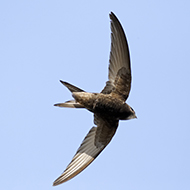
Swifts' crescent-shaped wings help to stabilise them as they glide during turbulent weather
Swifts are among nature’s best fliers, spending most of their time on the wing. Now scientists have shed new light on how these birds can glide with ease, whatever the weather.
Apparently, their crescent-shaped wings lessen the effects of blustery conditions, helping to stabilise the birds as they glide during turbulent weather. This means that swifts – which eat, mate and even sleep on the wing – are not forced to use up vital energy to stay on course.
Scientists at the University of Edinburgh constructed a triangular model wing with the characteristic trailing edge shape of swifts’ wings. They studied its aerodynamic properties by fitting it into a water flume that simulated airflow during flight.
Using a laser sheet and a digital camera, researchers tracked the movement of tiny glass balls in the water to reveal how air flows over the wing. Results show that as air passes over the wing, it can form two or three circulating regions of airflow – known as leading-edge vortices, or LEVs.
It is claimed that in aircraft with triangle-shaped wings, LEVs can generate extra lift. In swifts, however, the formation of LEVs appears to serve a different function. Researchers suggest that it may act as a ‘dampening’ mechanism that helps stabilise the birds’ wings as they glide in blustery weather.
Researchers say the findings could help inform the design of new aerial technology, similar to drones – known as micro air vehicles.
Dr Ignazio Maria Viola, of the University of Edinburgh’s School of Engineering, who led the study, said: “One of the most fascinating secrets in nature is how birds and insects can fly so effortlessly in turbulence. These results provide a small breakthrough towards unravelling this precious secret.”
The study is published in Royal Society Open Science. It was supported by the Engineering and Physical Sciences Research Council and the Consejo Nacional de Ciencia y Tecnologia.


 Companies marketing medicines for small pets exempt from authorisation must submit their annual return to the Veterinary Medicines Directorate (VMD) by 30 November 2026.



