


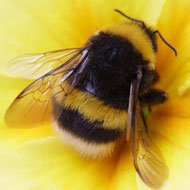
Study reveals bumblebee queens unable to start colonies
New research, conducted by Royal Holloway, University of London and the University of Guelph, has confirmed that bumblebees struggle to form colonies when exposed to a common neonicotinoid pesticide.
The research, published in Nature Ecology & Evolution, revealed that exposure to the pesticide led to a 26 per cent reduction in queen bees starting their own colonies.
This discovery is startling, given the challenge bumblebee queens already face, when starting new colonies. Queens can lose up to 80 per cent of their fat reserves during the winter, whilst simultaneously having to overcome the threat of parasites, predators, and a lack of resources.
Dr Gemma Baron from the School of Biological Sciences at Royal Holloway, said: “Creating new bee colonies is vital for the survival of bumblebees – if queens don’t produce eggs or start new colonies it is possible that bumblebees could die out completely.”
The research team used previous studies to build mathematical models of wild bumblebee populations, and determined that thiamethoxam significantly contributes to the possibility that bee populations may become extinct.
In addition to bees, neonicotinoids have been associated with the decline of butterfly populations and other species. This has led to a temporary ban on use of the product, issued by the EU; there is an ongoing global debate about whether or not this type of pesticide should be used, going forward.
Professor Vincent Jansen from the research team at Royal Holloway, said: “We used mathematical models to show that this reduction in colony founding is a very real threat to the survival of wild bumblebee populations. Neonicotinoids are the most widely used class of pesticide in the world. It is vital that we understand the effects of these pesticides on our wildlife before allowing their continued use.”
Professor Nigel Raine from the University of Guelph, stated: “This research shows that these pesticides can have a devastating effect on bees, and we urgently need to know more about how pesticides could be affecting other species.”
The study was funded by a BBSRC-DTG studentship, and the Insect Pollinators Initiative (joint-funded by the Biotechnology and Biological Sciences Research Council, DEFRA, the Natural Environment Research Council (NERC), the Scottish Government and the Wellcome Trust.


 Companies marketing medicines for small pets exempt from authorisation must submit their annual return to the Veterinary Medicines Directorate (VMD) by 30 November 2026.



