


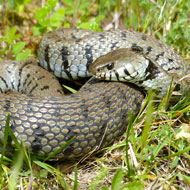
International scientists have revealed that the barred grass snake, previously thought to be a subspecies, is in fact a distinct species.
The newly-identified species, Natrix helvetica, is widely distributed throughout Great Britain, Switzerland, Italy and France, and also occurs in the western part of Germany.
Scientists led by the Senckenberg Research Institute in Germany studied over 1,600 grass snakes, many of which were museum specimens. The team worked in two areas where different genetic lineages come into contact; one in the Rhine region and the other extending from central Germany down to the southern Balkans. Such areas allow scientists to observe hybridisation and speciation.
The two contact zones in this study represent different stages of speciation, according to Science Daily. In the eastern zone there is a compete mixing of the genetic lineages involved over hundreds of kilometres. In the Rhine region, the hybrid zone is smaller (less than 50km wide) and the admixture is limited and unidirectional - barred grass snakes mainly cross-breed with eastern grass snakes, but rarely vice-versa.
“This indicates the presence of reproductive barriers,” explained Uwe Fritz, director of the Senckenberg collections. These occur during speciation to prevent mismatched pairings among different species. Together with the narrow hybrid zone, this suggests the barred grass snake is a distinct species.
The findings could have implications for conservation. Grass snakes are protected in Europe and classed as threatened or highly threatened in some countries.
Professor Fritz told Science Daily: “We now have to play close attention to which species of grass snake is involved in each case, in order to be able to assess whether one of them may be more threatened than previously thought.”
The full study has been published in Scientific Reports: https://www.nature.com/articles/s41598-017-07847-9
Image by Bernard DUPONT CC BY-SA 2.0


 Companies marketing medicines for small pets exempt from authorisation must submit their annual return to the Veterinary Medicines Directorate (VMD) by 30 November 2026.



