


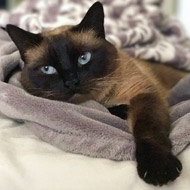
Removal ‘extremely rare’ in veterinary medicine
US cardiologists have removed a 13-centimetre heartworm from a cat’s femoral artery - a procedure which is believed to be a first in veterinary medicine.
When four-year-old Stormie was presented to specialists at UC Davis Veterinary Hospital, vets suspected heartworm in the arterial system. She had a history of heartworm disease and one of her rear legs had become lame.
After tests confirmed the diagnosis, cardiologists performed an echocardiogram which revealed a heartworm in the pulmonary artery and evidence of pulmonary hypertension in the lungs, from the heartworm disease.
The abdominal ultrasound that followed confirmed that the heartworm extended into her abdomen and down into the right femoral artery, cutting off the blood supply.
Acting fast to avoid amputating Stormie's leg, the team performed a CT angiography scan. This did not show any more heartworms but revealed there were abnormalities in the back right leg, likely secondary decreased blood flow from the worm. The scan also showed evidence of lung inflammation, which is also likely caused by the heartworms.
Cardiologist Dr Catherine Gunther-Harrington and Dr Ingrid Balsa, assisted by cardiology resident Dr Maureen Oldach, collaborated to successfully remove the 13-centimetre heartworm from Stormie’s right femoral artery without breaking it.
As blood flow returned to normal once they had removed the worm - and the tissue still looked healthy - the artery was repaired and the cardiologists decided amputation was not necessary. However, Stormie’s leg may require amputation in the future if the nerves and muscle in the leg do not heal properly.
In a press release, UC Davis Veterinary Medicine explained that ‘removal of a heartworm via the femoral artery is extremely rare in veterinary medicine’.
‘It has been reported only on a few occasions in dogs, but never cats,’ it reads. ‘Due to this uniqueness, Dr Oldach is currently preparing a case write-up for submission to a scientific journal’.
Stormie remained in the hospital for several days after her operation and was placed on a monthly heartworm preventative that she will need to continue for the rest of her life. To avoid future amputation, she is now on a physical rehabilitation programme and her owner is hopeful that she will continue to improve.
Image (C) UC Davis Veterinary Medicine.


 Eligible members of BEVA will be able to vote for their Council team until Monday, 17 August 2026. Members will have received an election email on 17 July.



