


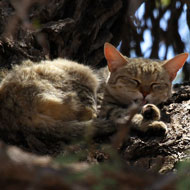
Domestic cats ‘derived from the Near East and Ancient Egypt’
DNA found at archaeological sites suggests domestic cats have their origin in the Near East and Ancient Egypt, and were domesticated by the first farmers around 10,000 years ago.
New research published in Nature Ecology & Evolution indicates that they later spread across Europe and other parts of the world via trade hub Egypt.
DNA analysis of cat bones and mummies also revealed that most of the ancient cats had stripes. Spotted cats were uncommon until the Middle Ages, which was long after the arrival of the first domesticated cats on the continent. Study authors believe that this suggests the initial domestication process may have focused on selection for behavioural traits, not coat colour or markings.
There are five known subspecies of wildcat, Felis silvestris, but it is not possible to see which was domesticated with the naked eye. All skeletons are alike and indistinguishable from domestic cats.
A team of international scientists set out to find the answer in genetic code, using DNA from the bones, skin, teeth and hair of more than 200 cats found at archeological sites in the Near East, Africa and Europe. The remains were between 100 and 9,000 years old.
All domestic cats are descended from the African wildcat or Felis silvestris lybica, a wildcat species found in North Africa and the Near East. It is thought cats were attracted to the first agricultural settlements, where rodents were rife. Farmers welcomed them as they helped to protect cereal grain from vermin. Over time, humans and cats became closer and selection based on behaviour led to the wildcat’s domestication.
Migrating farmers took the cats with them and at a later stage, they also spread around the world through trade hub Egypt. They were used to tackle vermin on Egyptian trade ships and travelled to large parts of South West Asia, Africa and Europe. Bones of cats with an Egyptian signature have even been found near the Baltic Sea.
Researcher Claudio Ottoni from the University of Leuven in Belgium said: “It’s still unclear, however, whether the Egyptian domestic cat descends from cats imported from the Near East or whether a separate, second domestication took place in Egypt. Further research will have to show.”
Image by Rute Martins of Leoa's Photography (www.leoa.co.za)/CC BY-SA 3.0


 Eligible members of BEVA will be able to vote for their Council team until Monday, 17 August 2026. Members will have received an election email on 17 July.



