


Ravens ‘remember those who treat them unfairly’
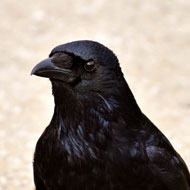
Six out of the seven birds tested chose to interact with the fair trainer.
New research suggests that ravens are able to remember which person treated them ‘fairly’ during a single interaction, and will subsequently show a preference for that person.
Scientists from the University of Vienna and Lund University tested how well ravens could distinguish between fair and unfair treatment, and if they preferred to interact with the person who treated them fairly.
Using nine ravens, they taught the birds to exchange a low quality reward (a crust of bread) for a high quality reward (a piece of cheese). In the ‘fair’ phase of the experiment, the trainer gave the bird a piece of bread crust to carry to the opposite end of the cage where a second researcher traded it for a piece of cheese.
In the ‘unfair’ part of the experiment, the same process was followed, except the researcher then ate the piece of cheese, instead of trading with the raven.
Two days later, six out of the seven birds tested chose to interact with the fair trainer, while the remaining bird chose to interact with a neutral trainer. The ability to memorise which trainer was fair and unfair lasted at least a month, researchers wrote in the journal Animal Behaviour.
Ravens who received ‘unfair’ treatment appeared to react in a frustrated manner; they started vocalising, showed increased activity and cached or ate the remainder of the low quality food. The research team say these behavioural expressions appear to confirm the perception of an unfair experience.
Birds that observed fair and unfair treatment, but did not experience it first hand, did not distinguish between trainers when given the choice.
Researchers wrote: ‘To conclude, we could show that ravens can remember from a single interaction sequence who acted cooperatively in the past and that they subsequently prefer to exchange reciprocally with this person, rather than with someone who acted uncooperatively in the past. Moreover, we showed that this memory can last at least 1 month.
‘In contrast, we could not find any proof that ravens that observed interactions of others could remember who was fair or unfair and transfer this third-party knowledge into first-person action. However, it did seem that experience with the paradigm increased the proficiency of observers.
‘As such we consider the exchange paradigm a promising avenue for the study of direct and indirect reciprocity. Whether it can help us to truly distinguish episodic memory from alternative explanations, however, needs further examination with larger sample sizes.’


 Companies marketing medicines for small pets exempt from authorisation must submit their annual return to the Veterinary Medicines Directorate (VMD) by 30 November 2026.



