


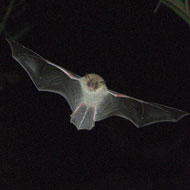
Rare species face disruption under white or green light
Switching to red streetlights could reduce the disruptive effects on rare bat species, according to a new study carried out in the Netherlands.
Artificial light can cause habitat loss among slow-flying bats as they hunt for insects in darkness to avoid predators and competition from other animals. Streetlights can leave species such as Natterer’s bats and brown long-eared bats vulnerable to owls and other predators.
Over a five-year period, scientists from the Netherlands Institute of Ecology studied bat activity levels under experimental white, green and red LED light conditions. They used eight study sites along forest edges in dark parts of the Netherlands, with four rows of streetlights in a single colour, and a control row of unlit streetlights.
The team found that light-shy bats were just as active in red light as they were in darkness, but white and green light substantially reduced their activity levels.
Lead researcher Kamiel Spoelstra said the research “opens up possibilities for limiting the disruption caused by external, artificial lighting in natural areas, in situations where having light is considered desirable”.
More agile bat species such as the pipistrelle, however, showed a strong increase in activity under white or green light, as insects are attracted to it. Larger species such as the serotine and lesser noctule fly higher and seem unaffected by either type of light.
"So for the more common species,” Spoelstra explained, "artificial light can serve as a facilitator while less common species face potential loss of habitat."
Researchers are aiming to issue advice on the use of artificial lighting by the end of the year, based on the responses of the species they studied.
Image by Guido Gerding/GNU Free Documentation License


 Companies marketing medicines for small pets exempt from authorisation must submit their annual return to the Veterinary Medicines Directorate (VMD) by 30 November 2026.



