


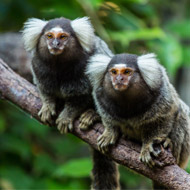
Similarities in human and marmoset infant speech development
Researchers at Princeton University have drawn parallels between the effects of feedback on the development of human infant speech and that of infant marmoset monkeys.
The report, published in Current Biology, found that as the vocal development of infant marmosets sped up, the more frequently they received vocal feedback from adults.
Although marmoset calls do not match the complexity of human language, infants in both species start their vocal development by making relatively random sounds.
Asif Ghanzanfar, senior co-author of the study and professor of psychology at the Princeton Neuroscience Institute, said: “We wanted to find out whether the idea that monkeys don't do any learning during their vocal development is actually true. So we picked a species that we know really relies on vocalisations as its primary social signals. What we found in marmoset vocal development very closely parallels pre-linguistic vocal development in humans.
“When an infant blurts out something and the parent responds, that's a contingent response. And the more often a parent provides that contingent response, the faster the human infant will develop its vocalisations.”
To ascertain these findings, the research team arranged an experiment in which pairs of fraternal twin marmosets were observed, starting one day after their birth. For 40 minutes each day, the infant marmosets were separated from the adults and, for the first 10 minutes, their noises were recorded. For the remaining 30 minutes, researchers provided contingent feedback to the infant marmosets in the form of audio playback of their parent’s calls.
In each set of twins, one marmoset received regular feedback, to mirror the response of an attentive parent. At the same time, the other twin received less feedback in response to their calls. This experiment was repeated each day for the first two months of the infants lives, which equates to around two years, in marmoset years.
Despite the short period of time each day, the infant marmoset twins who received consistent and regular feedback, developed mature-sounding vocals faster than the twins who received less feedback.
Ghanzanfar stated: “This system of vocal learning production may be linked to the idea that an infant that more quickly produces adult-sounding calls is more likely to get care from a caregiver in a cooperative breeding environment where multiple individuals could be that caregiver, in addition to the parents. So it's not only this process of learning that's similar to humans; the whole reproductive strategy is similar to humans."
Ghanzanfar went on to say: "Vocal production learning isn't just about imitation. And you can no longer say that non-human primates show no evidence of vocal learning."
The research team will continue to collect data on marmosets, with their next goal to gather information on their neural activity when they are conversing with one another and calling to neighbours. Scientists believe that, in understanding marmoset communication, they may be able to further understand the evolution and development of speech.


 Companies marketing medicines for small pets exempt from authorisation must submit their annual return to the Veterinary Medicines Directorate (VMD) by 30 November 2026.



