


Scientists explain flamingo’s unique pose
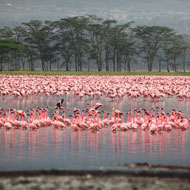
“The biomechanics are such that when they stand on one leg, they become very stable and are able to maintain that posture without activating muscle."
New research suggests flamingos expend less energy while standing on one leg, a finding that could have implications for robotics, artificial limbs and neurological or balance problems in humans.
The flamingo’s signature pose has long been a puzzle to scientists, but surprisingly research in this area is limited. New findings published in Biology Letters, however, suggest the behaviour is about reducing muscular effort.
Researchers from the Georgia Institute of Technology and Emory University studied live Chilean flamingos at Zoo Atlanta, as well as two cadaver birds from Birmingham Zoo and skeletons from UC Berkeley’s Museum of Palaeontology.
Their research shows that a ‘passively engaged gravitational stay apparatus’ helps the birds to support their weight and maintain balance while standing on a single thin leg. Its specialised anatomy and posture combine with gravity to give the flamingo its ability to stand and sleep while on one leg for long periods.
The posture does not involve bones locking into position; Professor Young-Hui Chang of Georgia Tech said it’s more like a hammock or sling than a lock.
“The biomechanics are such that when they stand on one leg, they become very stable and are able to maintain that posture without activating muscle,” explained Professor Lena Ting, of Emory University. “If they deviate from that posture to two legs, that no longer holds. It’s very posture-specific, a one-legged posture that can support the body weight.”
According to Prof Chang, the ‘passively engaged’ part of the flamingo’s gravitational stay apparatus requires minimal, if any, active muscular or nerve control.
While studying the cadaver birds, researchers found that they maintained their posture when they were placed in the one-legged position.
“Here we have a non-living animal able to stand on one leg,” Prof Chang commented. “Obviously, if it’s not alive, then the muscles are not activated.”
The researchers believe their findings could have applications in treating human movement and balance disorders. “If we know how much is passive mechanics and how much the nervous system has to control, it puts researchers in a better position to treat people,” Prof Chang explained.
Flamingo biomechanics could pave the way for better wearable artificial limbs and longer battery life for stability supports. There could also be implications for robotics, as getting robots to balance can be difficult. Currently it is done through sensing the environment and making adjustments, but designing the biomechanics of robots in the right way could make them more robust in uncertain environments.


 Companies marketing medicines for small pets exempt from authorisation must submit their annual return to the Veterinary Medicines Directorate (VMD) by 30 November 2026.



