
Your data on MRCVSonline
The nature of the services provided by Vision Media means that we might obtain certain information about you.
Please read our Data Protection and Privacy Policy for details.

In addition, (with your consent) some parts of our website may store a 'cookie' in your browser for the purposes of
functionality or performance monitoring.
Click here to manage your settings.
If you would like to forward this story on to a friend, simply fill in the form below and click send.

Your friend's email:
Your email:
Your name:
 
 
Send Cancel

Raccoon dogs ‘becoming more popular as pets’
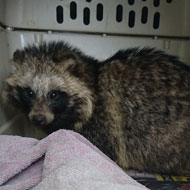
raccoon dog
RSPCA staff have renamed the raccoon dog Cedric.

RSPCA issues warning after stray pet found

The RSPCA is urging people not to buy pet raccoon dogs following a recent call-out to a stray, which was found by a member of the public.

In recent years the charity has dealt with a number of call-outs to stray pet raccoon dogs that have either escaped or been deliberately released into the wild.

The exotic mammal, also known as a tanuki, was discovered hiding under a water tank in a garden in Kirton Holme, near Boston.

Inspector Becky Harper said: “While he is very cute, we’d like to stress that raccoon dogs don’t make good pets. They are wild animals and, while they sadly seem to be becoming more popular as pets in the UK, we would strongly discourage people from buying or keeping one as a pet.

“They need a great deal of space and their needs cannot be met in a typical domestic environment. If they escape or are released into the wild they are a high invasive non-native species risk to our native wildlife.”

Releasing a non-native species into the wild, or allowing it to escape, is an offence under the Wildlife and Countryside Act 1981.

RSPCA staff have renamed the raccoon dog Cedric. Despite attempts to trace his owner, nobody has come forward to claim him so he will be rehomed to a specialist keeper.

Image courtesy of the RSPCA

Become a member or log in to add this story to your CPD history

Defra shares new Sanitary and Phytosanitary guidance

News Story 1
 Defra has published guidance for the vet sector ahead of a proposed UK-EU Sanitary and Phytosanitary agreement.

The agreement, which will change the movement and trade of animals and related products, could see reductions in checks, paperwork and certification. As well as describing regulatory developments, the advice highlights the importance of animal ID, registration and traceability in disease control and other compliance arrangements.

The guidance can be found here. More detail is expected as negotiations progress. 

Click here for more...
News Shorts
Lords Committee opens Pet Parasite Medication inquiry

The House of Lords Environment and Climate Change Committee will launch its inquiry into Pet Parasite Medication (PPM) on Wednesday (3 June).

Focusing on treatments containing fipronil and imidacloprid, the inquiry will seek to understand distribution pathways and the impacts of PPM use and non-use on biodiversity and human health. It will also cover current regulation, monitoring, and the potential implications for pets and their owners.

The committee will hear evidence from environmental non-governmental organisations and research institutes. The public can follow the proceedings live on Parliament TV or in person in the Palace of Westminster.

