


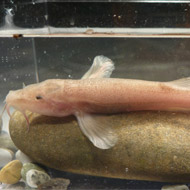
Fish discovered by divers exploring remote cave system
An underground cave system in Germany has yielded Europe’s first ever population of cave fish.
Researchers say the fish - a loach of the Barbatula species - exhibits traits typically observed in organisms adapted to subterranean life, including small eyes and a pale body.
Writing in Current Biology, they add that the newly-discovered population also represents globally the northernmost cave fish so far.
The cave fish was first observed in 2015 by a diver exploring the Danube-Aach cave system. The diver showed a photograph of the fish to Dr Jasminca Behrmann-Godel, a fish evolution expert at the University of Konstanz.
Speaking to BBC News, she said: "When I saw the photo I wasn't sure it was really something special. Then he brought me a live specimen and that was like the bang. That was the moment we realised that this was something really new!"
A genetic analysis on the cave fish revealed that it is a close relative of the stone loach - a species found in nearby rivers, the Danube and the Radolfzeller Aach. But researchers say they are not sure whether the fish can be classed as an individual species.
"The first thing you see is that they are pale, they appear a bit rose, or pinkish, because you can see the blood vessels through the skin," said Dr Behrmann-Godel.
"The eyes are still there, only about half the size of the surface fish population. If you put a light on them they don't react so we are not sure if they are still functioning. There is a change going on from the optical sense to some other perception capabilities."
It is thought that the cave system first became a suitable habitat for fishes when the glaciers retreated some 20,000 years ago. Researchers say they must have moved there at some point following the end of the Würm glacial period, seemingly from the Danube.
Image © University of Konstanz


 Companies marketing medicines for small pets exempt from authorisation must submit their annual return to the Veterinary Medicines Directorate (VMD) by 30 November 2026.



