


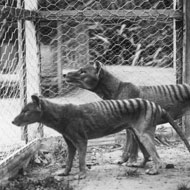
Scientists prepare for search in Queensland
Australian scientists are set to begin a search for the Tasmanian tiger, thought to have been extinct since 1936, after recent ‘plausible’ sightings in North Queensland.
The world’s last known Tasmanian tiger, or thylacine, died in Hobart Zoo in 1936 and the species was declared extinct in 1986 by international standards. Despite continued reports of sightings, no conclusive evidence of its existence has been found.
Researchers from James Cook University say there have recently been two ‘plausible and detailed’ descriptions of animals that could be thylacines. One of the observers was a long-time employee of the Queensland National Parks Service, and the other a frequent camper and outdoorsman in North Queensland.
Co-investigator Professor Bill Laurance said: “All observations of putative thylacines to date have been at night, and in one case four animals were observed at close range - about 20 feet away - with a spotlight.
“We have cross-checked the descriptions we received of eye-shine colour, body size and shape, animal behaviour, and other attributes, and these are inconsistent with known attributes of other large-bodied species in north Queensland such as dingoes, wild dogs or feral pigs.”
Beginning in the dry season, Dr Sandra Abell will lead a scientific search on the Cape York Peninsula, Far North Queensland, using more than 50 high-tech camera traps to survey prospective sites.
Both of the observers are providing detailed information on the locations of their sightings, which are at two separate sites. Prof Laurance said the locations are being handled with “the strictest confidence” so researchers are unable to disclose exactly where they are conducting the surveys.
Regardless of whether the species is detected, the surveys will provide important data on the status of mammal species on Cape York, where wildlife populations have undergone severe declines in recent years.
Image: Wikimedia Commons


 Companies marketing medicines for small pets exempt from authorisation must submit their annual return to the Veterinary Medicines Directorate (VMD) by 30 November 2026.




