


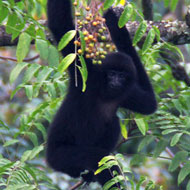
Efficient stoves and elephant grass help farmers and wildlife
Conservationists are providing Vietnamese farmers with efficient stoves and elephant grass in a bid to improve their lives and protect critically endangered gibbons.
The Cao-vit, or eastern black-crested gibbon, is only found in the forests of Trung Khanh, and in China’s nearby Guangxi province. It is the rarest ape in the world, after its closest relative, the Hainan gibbon.
This area of the remote Cao Bang province is one of Vietnam’s poorest regions and the local economy is largely driven by farming crops such as rice and corn.
Trung Khanh’s Cao-vit Management Board works with the conservation charity Fauna and Flora International, to conserve gibbons and other wildlife, as well as helping the local people.
Local people rely on firewood for cooking, often chopping down trees in the nearby forests where the gibbons live. The project aims to reduce reliance on firewood by providing local communities with fuel-efficient stoves at discounted prices.
Residents using the new stoves say they are quicker, easier to use and more effective, meaning bundles of wood last twice as long. The stoves also allow leftover cooking scraps to be used to build fires, and they produce little smoke, which presents a health hazard in poorly ventilated, often windowless homes.
Another FFI initiative teaches farmers to grow elephant grass to be used as livestock feed. The grass is able to withstand the harsh winters in Cao Bang and grows faster than normal grass. Foraging for livestock feed is a threat to the gibbon’s habitat, as well as being time-consuming for farmers.
Thanks to these and other initiatives, local residents now rarely encounter the gibbons as they have less need for resources from the forest.
Image courtesy of FFI


 Companies marketing medicines for small pets exempt from authorisation must submit their annual return to the Veterinary Medicines Directorate (VMD) by 30 November 2026.



