


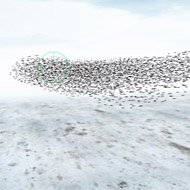
Researchers test the confusion effect
Researchers have created a computer game-style experiment which sheds new light on the reasons why starlings flock together to avoid predation.
There are many theories about why forming groups can reduce predation, but testing them is difficult in the wild.
In the game, the player takes on the role of a hawk and attempts to catch a single target starling in a flock of up to 5,000 simulated starlings.
Researchers explain that the game tests the confusion effect, which is the suggestion that predators may just be confused by the sheer number of potential prey.
“What we aimed to do was to find out whether or not confusion does occur in these massive and complex aggregations, like those of starlings,” said Benedict Hogan, a PhD student based at the School of Biological Sciences in Bristol.
“We found that, in line with the predictions of the confusion effect, participants had more difficulty in capturing a target starling in larger flocks, and in denser flocks; and that these effects interacted.
“This means we have evidence that suggests that starlings could indeed be safer from predation in larger and denser flocks, through the confusion of predators.”
Dr Hogan adds that it is likely that predator confusion is one of many functions of these impressive groups in starlings.
“Computerised experiments like this may allow us to test other potential functions in starling groups, and similar simulations may help others to understand the mechanisms and functions of complex groups in other species.”
‘The confusion effect when attacking simulated three-dimensional starling flocks’ by B.G. Hogan, H. Hildenbrandt, N.E. Scott-Samuel, I.C. Cuthill and C.K. Hemelrijk is published in Royal Society Open Science.
Image (C) University of Bristol.


 Companies marketing medicines for small pets exempt from authorisation must submit their annual return to the Veterinary Medicines Directorate (VMD) by 30 November 2026.



