


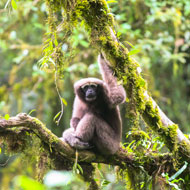
‘Skywalker hoolock’ named as a nod to Star Wars
A new gibbon species has been discovered in south-west China and named after Star Wars character Luke Skywalker.
The ‘Skywalker hoolock’ was found living in the forests of the Gaoligong mountains, but the research team who discovered it are already calling for it to be listed as endangered.
Scientists chose the name as a nod to the gibbon’s high treetop home, and the historical Chinese view of them as almost mystical beings.
A paper published in the American Journal of Primatology describes the new addition to the genus of hoolock gibbons (H. tianxing), which includes the western and eastern hoolock.
Led by Professor Fan Pengfei from the Sun Yat-sen University in Guangzhou, scientists looked at coat colour patterns and tooth morphology and studied the genetic characteristics of wild gibbons and museum specimens.
They conclude that the hoolock population living to the east of the Irawaddy-Nmai-Hka Rivers, which were previously thought to be eastern hoolocks (H. leuconedys), are in fact a distinct species from those west of the river.
One of the researchers, Dr Samuel Turvey of ZSL, commented: “The team are thrilled to have made this discovery. However, it’s also edged with sadness – as we’re also calling for the IUCN to immediately confer Endangered status on the Skywalker hoolock gibbon, which faces the same grave and imminent risk to its survival as many other small ape species in southern China and Southeast Asia due to habitat loss and hunting.
“Increased awareness of the remarkable ecosystem of the Gaoligong mountains and improved conservation is essential, to ensure we have time to get fully acquainted with this exciting new species before it’s too late.”
Image © Fan Pengfei


 Companies marketing medicines for small pets exempt from authorisation must submit their annual return to the Veterinary Medicines Directorate (VMD) by 30 November 2026.



