


Chimps observed using ‘drinking sticks’
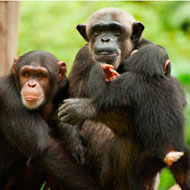
Chimps have previously been observed using a variety of tools, such as honey dipping probes and leaf-sponges to collect water. (stock photo)
Scientists believe they have discovered a new type of drinking tool being used by savanna chimpanzees in the Comoé National Park, Ivory Coast, in West Africa.
Over a period of six months during the dry season, the chimps were observed dipping for water in tree holes using specially modified sticks, which allowed them to gain water from otherwise inaccessible sources. The tools were used by chimps of all ages and sexes, in at least four different communities, suggesting the practice is widespread and habitual among the Comoé chimps.
However, while chimps have been observed using a variety of tools, such as honey dipping probes and leaf-sponges to collect water, the use of probes to dip for water is extremely rare. Researchers say this is the first time the practice has been observed as a widespread and well-established behaviour.
Comoé chimps live in a changeable environment, ranging from the rainy season when water is abundant, to the dry season, when water supplies are scarce and unevenly distributed.
The novel water dipping tool is fashioned by pulling a stick from a tree, reducing its length with the teeth or hands, removing leaves and branches, then creating a brush-like tip by chewing it to loosen the fibres. Some tools were modified further by removing the bark, changing their length after the first use or creating a second brush tip at the other end.
A total of 283 water dipping tools were found at 77 dipping sites in the south-west of the park - a study area of 900km2. The use of these tools peaked during the driest part of the season.
Researchers compared the water dipping tools with those for gathering honey, finding them to be longer, with thicker brush tips. Fifty water dipping sticks were tested in the laboratory, which revealed a significant positive correlation between the length of the brush and the amount of water absorbed.
Further research is needed to confirm that this is a habitual or customary behaviour in Comoé chimpanzees, as well as how the practice may have developed over time.
Prior to this research, nothing was known about the distribution, ecology or behaviour of the Comoé chimps. Researchers say their work shows the importance of studying threatened and isolated chimpanzee populations, which could offer important clues to our own evolution.
The full study has been published in the American Journal of Primatology: http://onlinelibrary.wiley.com/doi/10.1002/ajp.22628/full


 Companies marketing medicines for small pets exempt from authorisation must submit their annual return to the Veterinary Medicines Directorate (VMD) by 30 November 2026.



