


Feral cats now widespread throughout Australia
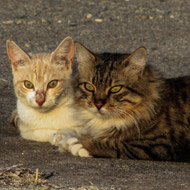
Sarah and her colleagues found that Australia’s feral cat population fluctuates between 2.1 million and 3.3 million.
Feral cats now cover more than 99.8 per cent of Australia - including its islands - according to new research.
The research, published in Biological Conservation, brought together 40 of Australia’s top environmental scientists and evidence from some 100 separate studies.
“Our study highlights the scale and impact of feral cats and the urgent need to develop effective control methods, and to target our efforts in areas where control will produce the biggest gains,” said lead author Dr Sarah Legge from the University of Queensland.
Sarah and her colleagues found that Australia’s feral cat population fluctuates between 2.1 million and 3.3 million, when widespread rain results in available prey.
The team also determined that cat densities were the same both inside and outside conservation reserves, such as national parks.
“This shows that declaring protected areas is not enough on its own to safeguard native wildlife,” said Dr Legge.
The research was funded by the Threatened Species Recovery Hub of the Australian Government’s National Environmental Science Programmes.
The Hub’s commissioner, Gregory Andrews, said the findings substantiated the need for a humane and effective cull.
“The density of feral cats in Australia is lower than it is in North America and Europe, and yet feral cats have been devastating for our wildlife,” he said.
“Aside from Antarctica, Australia is the only continent where animals evolved without cats, which is a reason our wildlife has been so vulnerable.
“Feral cats have already driven at least 20 Australian mammals to extinction, which makes investing in research like this important.
“This science reaffirms the importance of ambitious targets to cull feral cats, which I am implementing with the support of Minister for Environment and Energy Josh Frydenberg under the Threatened Species Strategy.”


 Companies marketing medicines for small pets exempt from authorisation must submit their annual return to the Veterinary Medicines Directorate (VMD) by 30 November 2026.



