


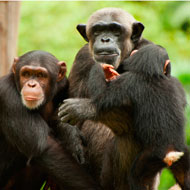
Researchers test ‘face inversion effect’
Chimpanzees recognise one another from their behinds, in a similar way that humans recognise faces, according to new research.
In humans, distinct features like eye-whites, eyebrows and red cheeks signify good health and sexual attraction.
In chimpanzees, the buttocks serve a similar purpose. For example, when females are ovulating, the area around the genitals swells and reddens in colour.
'Faces are enormously important for people, and all the features of our faces are optimally arranged to be seen and to communicate,” said study author Maria Kret.
“In the course of evolution, our faces have acquired more contrast: red lips, the whites of our eyes, eyebrows and a smooth skin that makes everything more visible.”
In the study, researchers from Leiden and Kyoto Universities tested chimpanzees' ability to recognise each other by using the 'face inversion effect'. This is where the brain recognises faces faster than objects. However, this does not apply if the faces are inverted.
The researchers tested humans and chimpanzees by showing them photographs of faces and buttocks upright and inverted. The participants could indicate on a touchscreen which faces and buttocks they recognised.
The researchers found that the chimpanzees were faster in clicking on the buttocks when they were upright rather than introverted.
"This is a good indication that this category has priority over other categories of objects," said Kret.
The researchers say their finding provides an insight into the underlying mechanisms of how we recognise one another and how that may have changed over the course of evolution.
'These findings suggest an evolutionary shift in socio-sexual signalling function from behinds to faces,' the authors conclude. 'Two hairless, symmetrical and attractive body parts, which might have attuned the human brain to process faces, and the human face to become more behind-like'.
The study, Getting to the Bottom of Face Processing. Species-Specific Inversion Effects for Faces and Behinds in Humans and Chimpanzees, is published in PLOS ONE.


 Companies marketing medicines for small pets exempt from authorisation must submit their annual return to the Veterinary Medicines Directorate (VMD) by 30 November 2026.



