


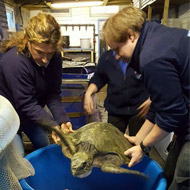
Olive ridley found stranded on Anglesea beach
A tropical sea turtle that washed up on a beach in Wales has been confirmed as an olive ridley - the first its kind in the UK.
‘Menai’ was found stranded on Tan-Y-Foel beach close to Anglesea Sea Zoo on Saturday afternoon.
When zoo staff were called to the stranding, they were 99 per cent sure she was an olive ridley. However, because the species has never been recorded before in the UK, they wanted to be 100 per cent sure before they confirmed.
“We have now had confirmation from numerous experts that she is indeed an olive ridley turtle and as such the first of her kind ever recorded in Great Britain or Ireland,” said Ms Frankie Hobro, director and owner of Anglesea Sea Zoo.
“As you can imagine this is cause of great excitement! Olive ridley turtles are normally found in warm waters around the Pacific and Indian Oceans, and the closest breeding ground that we know of in the Atlantic is in Gabon, Africa. So Menai is a long way from home!”
Named after the greenish colour of their skin and shell, olive ridleys are best known for their behaviour of synchronised nesting in mass numbers.
The species is listed as endangered under the IUCN due to the threats it faces across its range - such as the exploitation of its eggs and the females when they come on to land to lay, and mortality due to unsustainable fishing practices.
“We envisage that [Menai] must have been swept clockwise via the Atlantic Gyre current; across to the west from Southern Africa, up past the East coast of America and then back across to the UK with the Gulf Stream,” Ms Hobro adds. “This totals a distance of around 15,000 miles. What an incredible journey!”
Menai remains in a critical condition and is being carefully rehabilitated behind the scenes at Anglesey Sea Zoo, where staff are raising her ambient temperature gradually on a daily basis.
The zoo are now liaising with rehabilitation centres abroad who specialise in the active rehabilitation and release of olive ridley turtles. Should she be sufficiently well recovered, the zoo will fly Menai back home to ensure her continued rehabilitation and eventual release back into the wild.
Image (C) Anglesea Sea Zoo


 Companies marketing medicines for small pets exempt from authorisation must submit their annual return to the Veterinary Medicines Directorate (VMD) by 30 November 2026.



