


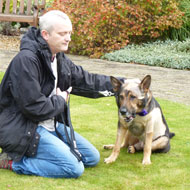
Minister to look at greater legal protection for police animals
The government is set to support calls for police animals to be given greater legal protection when they are injured in the line of duty.
A parliamentary debate on Monday (14 November) saw cross-party MPs urge the government to introduce tougher penalties for those who attack police dogs and horses.
The debate was prompted by a petition calling for police animals to be given equal status to human police officers, after a police dog, Finn, and his handler were recently stabbed while pursuing a suspect.
As the law stands, those who attack police animals can be prosecuted under the Animal Welfare Act 2006 - facing a maximum of six months in prison and an unlimited fine - or for more serious cases, the Criminal Damage Act 1971 - which allows for up to 10 years in prison.
However, as MPs pointed out, many offences go unreported as successful prosecution is so unlikely. Figures from the House of Commons library show that in 2015, the average custodial sentence for Animal Welfare Act prosecutions was 3.3 months, and the average fine £244. Custodial sentences were only applied in 10 per cent of convictions.
The minister of policing and the fire service, Brandon Lewis, said he has written to the Ministry of Justice and Defra to explore whether more can be done in law to offer protection.
Work will be done with the Sentencing Council to ensure the current legislation is being appropriately used and, if further legislation is found to be required, the minister will seek to address this in 2017.
David Mackintosh MP, who led the debate, welcomed the minister's comments and said he hopes to see something in the Queen's speech next year.
Image © Hertfordshire Constabulary


 Eligible members of BEVA will be able to vote for their Council team until Monday, 17 August 2026. Members will have received an election email on 17 July.



