


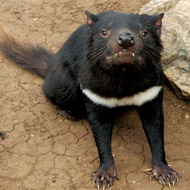
Animals show resistance to deadly facial cancer
Tasmanian devils have developed some genetic resistance to a devastating facial cancer that has plagued the species for 20 years.
Devil facial tumour disease (DFTD) has reduced the Tasmanian devil population by 80 per cent since it was first reported in 1996, and scientists predict that within decades it could wipe the species out altogether.
But new research shows that Tasmanian devils have developed some resistance to the disease in as little as four to six generations.
In the study, published in Nature Communications, the team sampled 294 Tasmanian devils from three different populations. The samples were from before and after those groups encountered the disease.
They found that two of the genes, CD146 and THY1, were increasing in frequency throughout the devil populations and appeared to be helping their immune system to recognise foreign cells.
Speaking to BBC News, Dr Andrew Storfer from Washington State University, said this was cause for optimism.
"First and foremost, this gives us hope for the survival of the Tasmanian devil, which is predicted to be extinct but isn't," he said. "We see that the devils apparently are evolving genes that may be associated with resistance to the disease."
Dr Stormer, an evolutionary geneticist, was particularly excited at the speed at which the adaptions appeared to be happening.
"We're talking about roughly six generations in some populations, which is a very short period of evolutionary time."
DFTD is a transmissible cancer that is spread by biting and causes the appearance of tumours on the face or inside the mouth of affected individuals. The tumours are often very large and usually fatal.
The team say their research offers several avenues of hope for Tasmanian devil conservation, such as breeding programmes and vaccination studies.
Image (C) KeresH/Wikimedia Commons


 Companies marketing medicines for small pets exempt from authorisation must submit their annual return to the Veterinary Medicines Directorate (VMD) by 30 November 2026.



