


Lens used to view previously ‘invisible’ structures
Scientists have used spider silk to create a ‘superlens’ that enhances the power of a microscope by as much as three times.
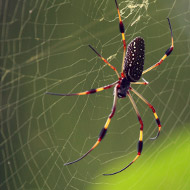
Writing in the journal Nano Letters, scientists from Bangor and Oxford universities explain how they used a cylindrical piece of spider silk from the golden web spider as a lens.
They say the lens could be used to see 'invisible’ structures, including some germs and viruses.
Physical laws of light make it impossible to view objects smaller than 200nm – the smallest size of bacteria – using a normal microscope alone.
Bangor University explained that extending the limit of the classical microscope’s resolution has been the ‘holy grail’ of microscopy for over a century.
While the scientists have engineered a man-made material to break the perceived resolution barrier, it is the first time they have used a naturally occurring biological material in this way.
Professor Fritz Vollrath of the University of Oxford described the discovery as ‘very exciting’.
The cylindrical silk works in much the same way as looking through a glass or bottle. The clearest image only runs along the narrow strip directly opposite the viewer’s line of vision or resting on the surface being viewed.
Dr Zengbo Wang, who led the study, explained: "The cylindrical silk lens has advantages in the larger field-of-view when compared to a microsphere superlens.
“Importantly for potential commercial applications, a spider-silk nanoscope would be robust and economical, which in turn could provide excellent manufacturing platforms for a wide range of applications."
Golden web spiders - also known as Banana spiders - are widespread in warmer regions throughout the world. Black and yellow in colour, the creatures are famed for their brightly coloured, intricate webs.
Image (C) CharlesJSharp/Wikimedia Commons


 Companies marketing medicines for small pets exempt from authorisation must submit their annual return to the Veterinary Medicines Directorate (VMD) by 30 November 2026.



