


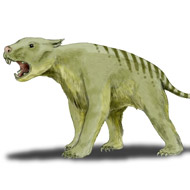
Used teeth to grip prey before killing with claws
A new study suggests that the extinct marsupial lion hunted in a highly unique way.
Published in the journal Paleobiology, researchers found the Thylacoleo carnifex used its teeth to grip prey before killing them with its huge claws.
The method is in contrast to modern cats, who use their forelimbs to manipulate their prey before taking a bite.
The marsupial lion lived around two-and-a-half-million years ago and was around the size of a large jaguar.
A significant characteristic of the marsupial lion was its very large claws - similar to those found on dew cats, but of a much bigger size.
In the study, researchers from the universities of Bristol and Malaga looked at the elbow joints of living mammals.
They found the Thylacoleo had a unique elbow joint, similar to those found in climbing animals that allow for rotation of the hand around the elbow. Living cats which use their forelimbs to grapple their prey have an elbow joint of intermediate shape, they write.
Furthermore, the animal’s large incisors were blunt, making them better for gripping than for piercing flesh.
“If Thylacoleo had hunted like a lion using its forelimbs to manipulate its prey, then its elbow joint should have been lion-like,” said Christine Janis from the University of Bristol.
“But, surprisingly, it’s a unique elbow-joint among living predatory mammals - one that suggested a great deal of rotational capacity of the hand, like an arboreal mammal, but also features not seen in living climbers, that would have stabilised the limb on the ground, suggesting that it was not simply a climber.”
Image (C) Nobu Tamura


 Companies marketing medicines for small pets exempt from authorisation must submit their annual return to the Veterinary Medicines Directorate (VMD) by 30 November 2026.



