


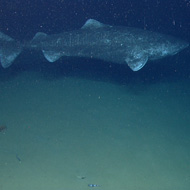
Oldest sharks estimated to be around 400 years old
For the first time scientists have managed to estimate the age of Greenland sharks, revealing them to be the longest-living vertebrate known to science.
The species was found to have a life expectancy of at least 272 years, but researchers estimated the oldest animals to be around 400 years old.
Until now, the lifespan of Greenland sharks has been a mystery as their age cannot be determined with traditional methods used for fish.
Led by the University of Copenhagen, marine biologists used carbon-14 dating of eye lenses to estimate the ages of 28 female Greenland sharks.
Their findings have been published in the journal Science.
Lead author Julius Nielsen explained: "As with other vertebrates, the lenses consist of a unique type of metabolically inactive tissue. Because the center of the lens does not change from the time of a shark's birth, it allows the tissue’s chemical composition to reveal a shark’s age.
"We use well-established radiocarbon methods, but combine them in a new way."
Generally, carbon-14 dating is used for archaeological dating but it can be used for Greenland sharks too because of their extremely long life expectancy.
Researchers hope their findings will bring more attention to the species in future. Nielsen added: "Greenland sharks are among the largest carnivorous sharks on the planet, and their role as an apex predator in the Arctic ecosystem is totally overlooked.
"By the thousands, they accidentally end up as by-catch across the North Atlantic and I hope that our studies can bring a greater focus on the Greenland shark in the future."
Image © NOAA Photo Library/CC BY 2.0


 Companies marketing medicines for small pets exempt from authorisation must submit their annual return to the Veterinary Medicines Directorate (VMD) by 30 November 2026.



