


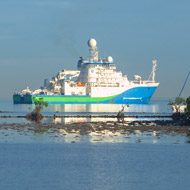
Ship will expose students to world-class scientific equipment
A new training programme is set to transform a marine science ship into a floating classroom.
The CAPSTAN initiative (Collaborative Australian Postgraduate Sea Training Alliance Network) will give marine science students dedicated time on board the research vessel Investigator.
Owned by the Marine National Facility, the ship will expose students and trainers to an array of world-class scientific equipment and technology.
The programme is the first of its kind in Australia and will provide a collaborative national approach to teaching future generations of marine science.
Director of CSIRO Marine National Facility, Ron Plaschke, said it provides a fantastic opportunity for Australian marine scientists.
"This programme provides practical training for students on board a multi- disciplinary ocean class research vessel," he said. "It gives students, and trainers, learning opportunities that are not available anywhere else in Australia."
Investigator can operate anywhere from the ice edge to the equator. It can also study the deepest oceans, as well as the atmosphere above.
So far, voyages have already discovered undersea volcanoes, investigated climate change, mapped tectonic plate boundaries and found rare deep-sea creatures. They have also provided important information to monitor changes in our ocean environment.
"We're extremely pleased with this collaboration with CSIRO Marine National Facility, and this program will change the landscape of marine science education in Australia," said programme leader Dr Armand.
"We can't wait until the first students are on board and get underway on their voyage - it's an exceptional project and groundbreaking partnership between Australian research institutions, industry and our nation's leading science agency."
Image (C) Doug Toust/CSIRO Marine Laboratories


 Companies marketing medicines for small pets exempt from authorisation must submit their annual return to the Veterinary Medicines Directorate (VMD) by 30 November 2026.



